Technical  Idle problem (P0505)

Currently reading:
Technical  Idle problem (P0505)

hellomyfriend

New member
Joined
Jul 16, 2026
Messages
10
Points
26
Location
Hungary
Hello,

I have a 2007 Fiat Bravo 1.4 16V (90 HP) with a P0505 fault code and a problem that nobody has been able to diagnose.
  • With no electrical load, the engine idles perfectly.
  • As soon as I switch on the headlights or any other electrical load, the idle starts fluctuating.
  • With the A/C on, the compressor clutch cycles on and off continuously at idle.
  • The car also jerks slightly under light throttle between 1000–2000 RPM.
  • The throttle body and MAP sensor have been cleaned.
  • The alternator has been professionally rebuilt, but the problem remained.
  • The charging voltage is around 14.2 V.
The strange part is that if I disconnect the thick B+ cable from the alternator, the engine immediately runs perfectly: the idle becomes stable, the A/C works normally, and the jerking disappears.

I’ve already consulted several mechanics and Fiat dealerships, but nobody has been able to identify the cause.

Has anyone experienced something similar or knows what else could cause this?
IMG_3430.jpeg
 
Model
Bravo 1.4 16V 90HP
Year
2007
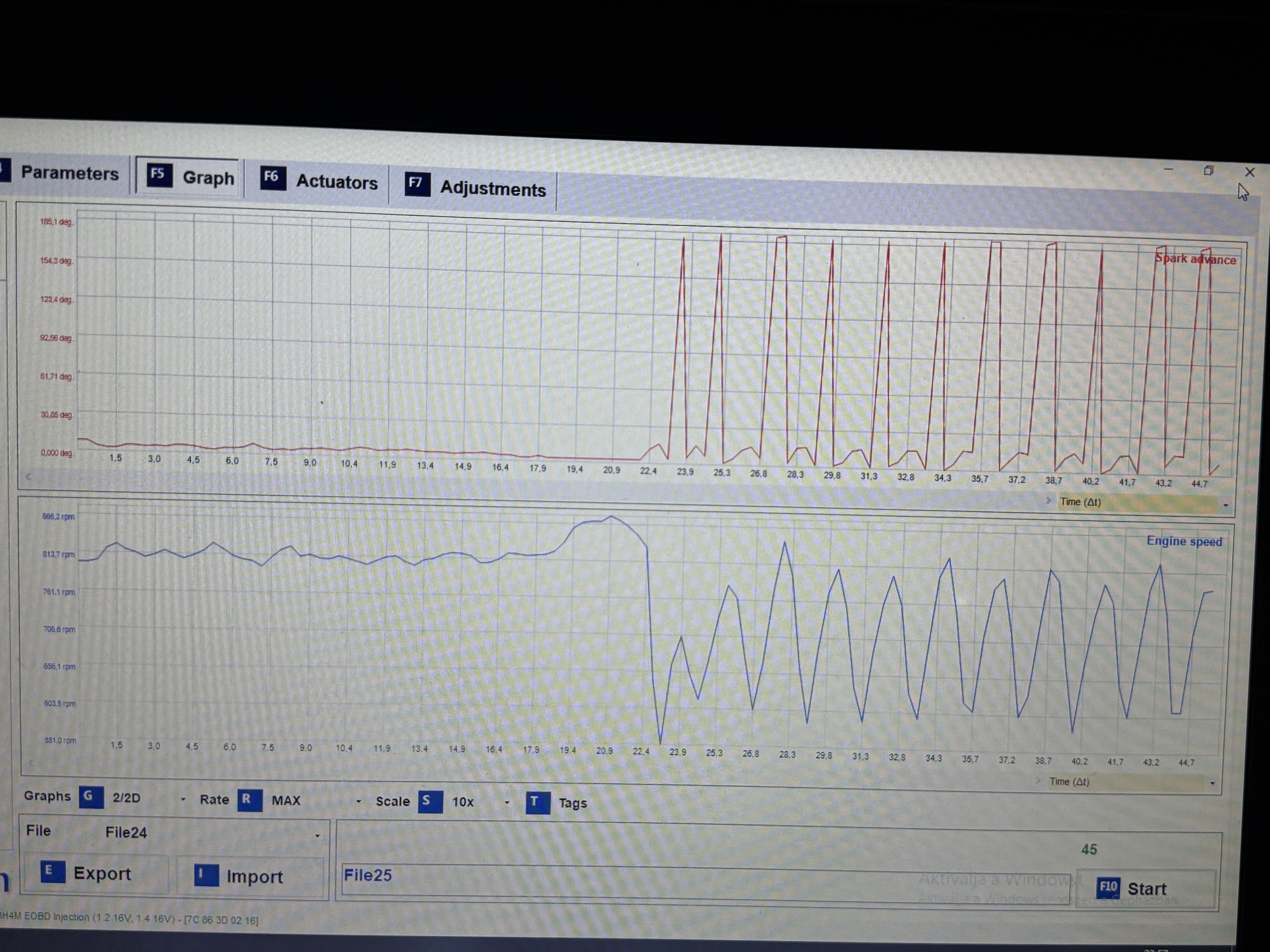
At the beginning of the recording, no electrical loads were switched on. At the 33-second mark, I turned on the low beam and high beam headlights. Then, at the 66-second mark, I switched them off again.
IMG_3438.png
 

Attachments

  • IMG_3439.png
    IMG_3439.png
    317.4 KB · Views: 4
  • IMG_3438.png
    IMG_3438.png
    158.5 KB · Views: 4
Did you do the throttle body relearn procedure?

Did you check or clean the main ground cable?

There is no throttle body relearn procedure available for this ECU in MultiECUScan. The only relevant function I found is “Reset Self-Adaptive Parameters”. I performed that reset, but unfortunately it didn’t help.

I haven’t checked the engine ground strap yet because, to be honest, I don’t even know where it’s located. However, I did use a multimeter to measure the voltage between the battery negative terminal and various ground points, and I also measured resistance. I couldn’t find anything abnormal. The voltage measured directly across the battery terminals is also the same as the voltage I measure at the alternator.
 
The strange part is that if I disconnect the thick B+ cable from the alternator, the engine immediately runs perfectly: the idle becomes stable, the A/C works normally, and the jerking disappears.
That part is really intriguing and does sound like there is the problem somewhere.
You say alternator was professionally rebuilt, but somewhere there is an electrical problem.
When and how did the problem started? Do you remember the details?
 
Here’s another recording. The headlights were turned on between 19 and 38 seconds.


This happens with any electrical load, not just the headlights. The idle starts fluctuating the same way if the cooling fan turns on, if I switch on the rear window defroster, or with any other significant electrical consumer.

IMG_3440.png
 
I bought the car about a month ago with this issue already present, so I don’t know when it first started or how long the previous owner had been dealing with it.


The seller told me that the idle only fluctuated when the A/C was turned on, and he demonstrated exactly that. Since I bought the car during the day, I never thought to switch on the headlights, so I didn’t realize that the idle also fluctuates with any other electrical load. If I had known that, I’m not sure I would have bought the car.
 
During the alternator rebuild, the bearings, diode bridge, and voltage regulator were replaced, and the slip rings were resurfaced. Is it possible that there’s still a problem with the stator or rotor windings? Would it be worth buying a completely new alternator?
 
With a good multimeter you can mesure the AC voltage your alternator puts out. It should be under 50 mV.
I measured the AC ripple voltage as well. When I switch on an electrical load and the idle starts fluctuating, the AC voltage continuously varies between 0.10 V and 0.25 V. When I switch the electrical loads off and the idle becomes stable again, the AC voltage drops to about 0.08 V.

IMG_3448.jpeg


IMG_3449.jpeg
 
My guess is it is a software update that is needed for the ECU, as it is not compensating the engine revs for when electrical load such as Air Con or lighting etc.is activated.
Years ago on Nissan Bluebirds I recall seeing a real drop in engine revs when you turned on lights etc.
Modern vehicles have high output alternators so when they cut in, they take a lot of the engine power to provide the extra amps.
Just a thought although alternator is physically working, is it possible it is not the correct one for that model, I know modern alternators have a different more advanced way of control via the ECU than earlier alternators. Including shutting off output to increase engine power at certain times.
No claims to be be electrical specialist, my thoughts are based more on my knowledge of the mechanical side.:)
 
My guess is it is a software update that is needed for the ECU, as it is not compensating the engine revs for when electrical load such as Air Con or lighting etc.is activated.
Years ago on Nissan Bluebirds I recall seeing a real drop in engine revs when you turned on lights etc.
Modern vehicles have high output alternators so when they cut in, they take a lot of the engine power to provide the extra amps.
Just a thought although alternator is physically working, is it possible it is not the correct one for that model, I know modern alternators have a different more advanced way of control via the ECU than earlier alternators. Including shutting off output to increase engine power at certain times.
No claims to be be electrical specialist, my thoughts are based more on my knowledge of the mechanical side.:)

I called several Fiat dealerships to book a service appointment, but they all told me they no longer have the equipment to diagnose this old car. Based on that, I don’t think they would be able to update the ECU software either.

A mechanic installed another engine ECU in the car for testing, but the problem was exactly the same with that one.

I didn’t take a photo of the alternator label, so I don’t know the exact part number. However, I know it’s a 90 A Denso alternator, and I think it’s the original factory-installed unit.
 
I measured the AC ripple voltage as well. When I switch on an electrical load and the idle starts fluctuating, the AC voltage continuously varies between 0.10 V and 0.25 V. When I switch the electrical loads off and the idle becomes stable again, the AC voltage drops to about 0.08 V.
There you go, that is the problem!
Under 50 mV is ideal, 80 is acceptable. You have more than that with consumers on and the engine suffers. The diode bridge transforms AC to DC and values you get there are clearly over the Max safe line.
Who knows what happened with the alternator rebuilding or maybe the previous owner made a shortcut at some point. That fries the diodes.
I would say a new alternator would be the fix. Or if you want to try, you could put new diodes bridge on that one. But I wouldn't do that. Better and safer just a new alternator.
 
Last edited:
A mechanic installed another engine ECU in the car for testing, but the problem was exactly the same with that one.

I didn’t take a photo of the alternator label, so I don’t know the exact part number. However, I know it’s a 90 A Denso alternator, and I think it’s the original factory-installed unit.
Yes, it's not the ECU.
And your alternator is direct charging, not smart charging. No ECU voltage control, just classic voltage regulator. Smart charging systems have the module that communicates with ECU on the battery ground line, on the battery or very close to it.
Yours doesn't have that, right? It's just the cable with nothing else.
 
Yes, it's not the ECU.
And your alternator is direct charging, not smart charging. No ECU voltage control, just classic voltage regulator. Smart charging systems have the module that communicates with ECU on the battery ground line, on the battery or very close to it.
Yours doesn't have that, right? It's just the cable with nothing else.
There is nothing connected to or near the battery’s negative terminal.

My alternator has two wires connected to it: one thick red wire and one thin red wire. I assume the thick red wire is the main charging output (B+), while the thin red wire is probably the excitation or control wire. As far as I know, this is not a smart alternator.
 
Back
Top