I agree with all that
@bugsymike has said.
Here's a page from the Haynes workshop manual on the 124 Coupe covering the overhaul of the rear brake caliper plus an enlarged illustration of the caliper handbrake auto-adjuster (I realize you may already have this info, but just in case you don't..) :-
In the past (last century, in fact) I worked as a Fiat dealership Mechanic on these, now old, Fiats and worked on those calipers (+ everything else).
As 'bugsymike' has suggested, the internal parts for the auto-adjuster are not usually available but I did strip and swap parts between old calipers to make one work. The caliper auto-adjuster could be fully dismantled on early calipers, later ones had a spun disc inside as a deterrent to disassembly. An original Fiat parts book shows the breakdown of the caliper but not the internals of the caliper piston but it shows what parts are included in the various parts kits that were available (little box in upper RH side of illustration). There was no part no. given for the piston, only the complete caliper.
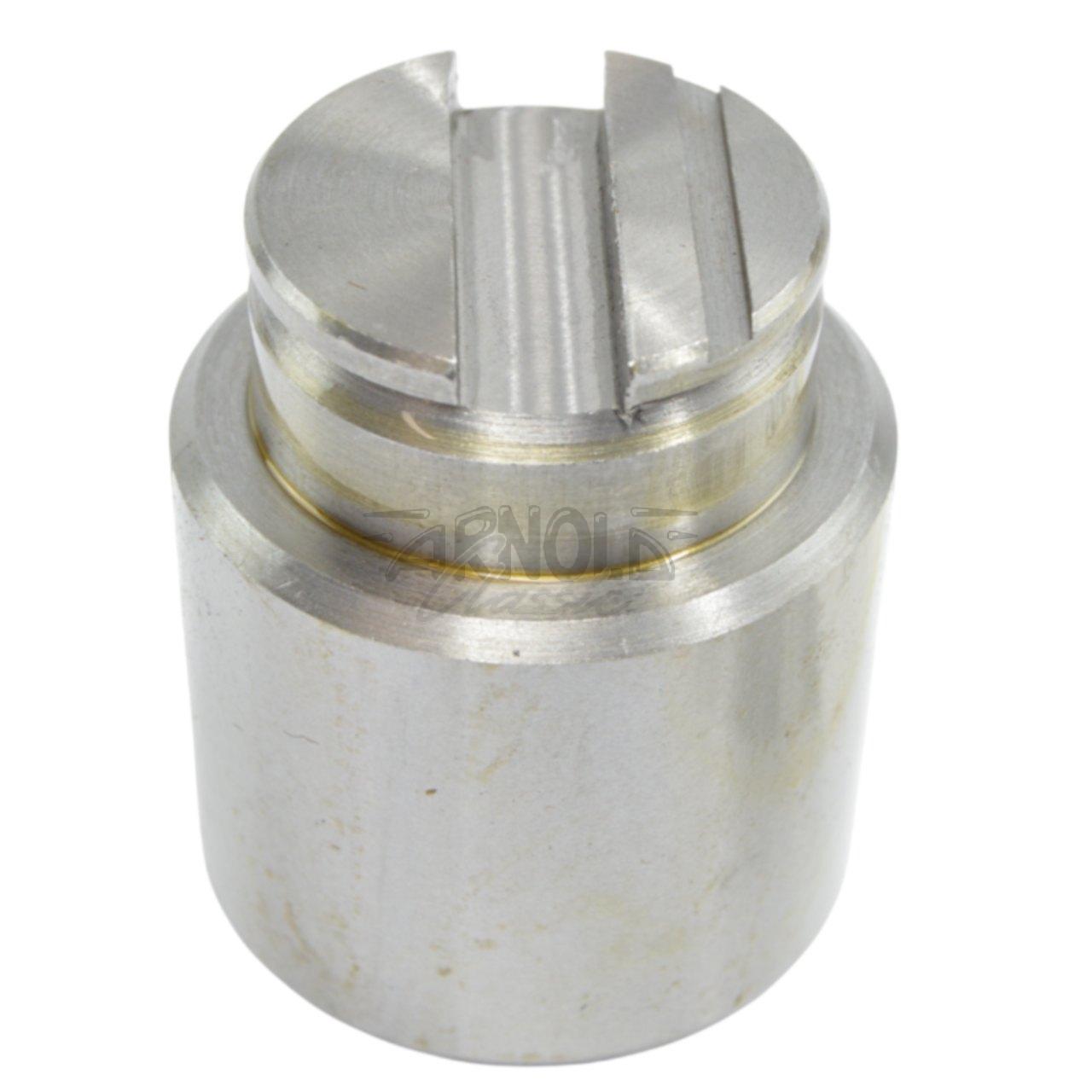
However the piston unit is available currently (just check the piston diameter is correct, there may have been 2 sizes used), so no need to buy a complete replacement caliper, the seals are readily available. e.g. from
https://autoricambi.us but you probably have suppliers nearer to you :-
Now, bearing in mind that I'm relying on memory from c. 45 years ago, so I may not have this exactly correct, but iirc the rear brake caliper handbrake auto-adjuster adjusts up by small increments each time the handbrake operating lever at the caliper is operated and released, the adjustment takes place during the release part of the movement of the operating arm.
This can be seen with the caliper removed from the caliper mounting bracket, operating the short handbrake operating lever on the caliper, the piston will move outwards slightly but will retract slightly less if the internal adjuster is working correctly, repeated operation of the op. lever should result in the piston moving slowly/progressively outwards to take up brake pad wear.
I haven't been able so far to find a description of how the adjust works exactly, but afaik the internal spring grips and causes the adjuster nut to rotate slightly each time during release. I think I can see a tiny gap between the end of the nut and the piston bore - this might be enough to squash the spring when the handbrake is operated and then when released, cause the spring to twist the nut as it tries to unwind from having been compressed?
The problems I encountered were failed diaphragm springs (belleville-type washers) - split due to water ingress/corrosion and the tail end of the nut spring breaking off (which is why I earlier mentioned stripping 2 calipers and swapping parts around to make one good unit). I do recall that when refitting the piston, (if only the piston was removed to replace seals) the adjusting screw had to be held centrally and engaged with the adjusting nut inside the caliper piston by turning the piston. In fact when you wind the piston inwards (clockwise both sides) e.g. when fitting new brake pads, what you're doing is winding the piston and internal nut onto the adjusting screw/plunger, forcing the piston in will likely only cause damage, it has to be rotated and of course, as stated previously, the piston should finish with the little alignment mark above the deep groove to allow the brakes to be bled of air.
Here's an illustration of a (Girling) handbrake adjuster incorporated into a brake caliper - this is a ratchet type but I think the operation is somewhat similar to what is on the Fiat (Bendix, iirc), except the Fiat uses a peculiar nut and spring combination instead of the ratchet.
As regards adjusting the handbrake, 3 clicks is too tight - Fiat iirc used to state 4 - 6 clicks but to ensure that when released there is no brake binding/dragging. There were often complaints that the lever travel was excessive or that the handbrake was poor (it should still hold the car on a reasonable slope).
After bleeding the brakes, I would ensure the handbrake cables were backed off sufficiently to allow the handbrake operating levers on the calipers to return to their stops (as 'bugsymike' has emphasised) then apply and hold the footbrake, operate the handbrake lever repeatedly, then release the footbrake and try the handbrake, repeat the adjustment procedure if necessary, then finally adjust the handbrake cable to give 4-6 clicks of movement ensuring the that there is no binding (if there is, back off the cable adjustment). Top-up the brake fluid if necessary. The pedal should be solid, hold down, then start engine, pedal should drop slightly showing that the servo is working normally. Before road-testing, re-torque wheel bolts.
I'll search and should I find any proper/definitive info on how this caliper handbrake auto-adjuster actually works I'll post it here.


 ) search on your behalf and only found one supplier, in (afaik) Germany, that lists the rear brake piston - however, I can't see if the piston includes the internal auto adjuster parts - it might be advisable to contact them to verify this before ordering (there's a 'Related Link' at the bottom of the page to do this) (and the price does seem rather high if it's just a bare piston):-