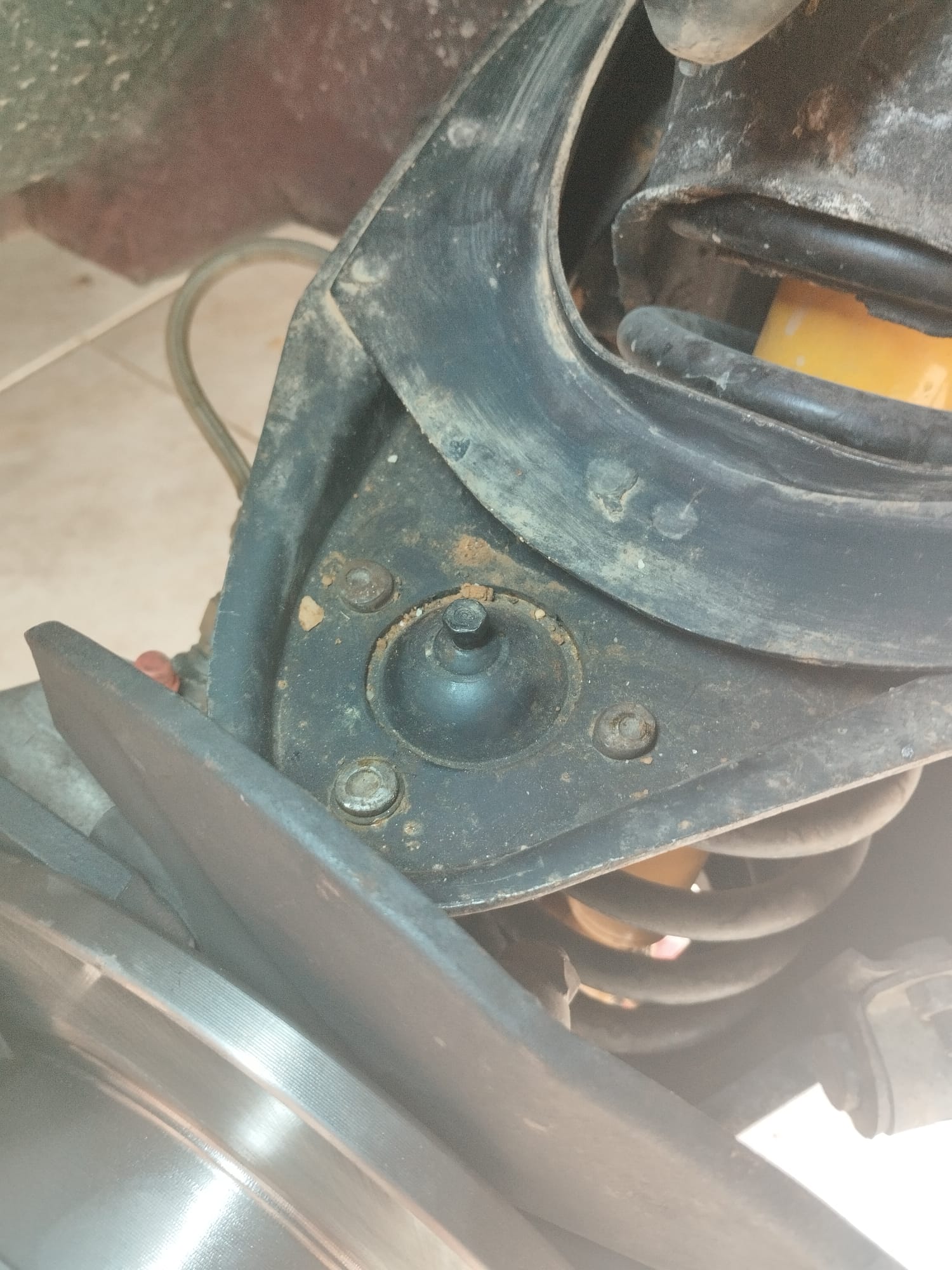
The original ball joints on the early Coupes had a separate rubber boot attached to a sheet metal plate so, in theory, the boot alone could be changed and the joint re-used if unworn (a bit of a faff though as the rivets had to be drilled out anyway and the ball joint refitted using bolts and nuts).
The top and bottom ball joints
are different - if you consult your Haynes manual and check out 'Fig. 11.3. Section of L.H. front wheel and suspension' you can examine the cross sectional view of both ball joints :-
View attachment 490147
Because of how the suspension is loaded in use, the top ball joint ball pin is mainly being pushed up against the top plate of the ball joint, whereas the lower ball joint pin is mainly being pulled up and out of the ball joint - this difference in direction of main loading requires different methods of construction.
The 'top-hat' protrusion on the original bottom ball joints, contained, iirc, a rubber spacer to take up any slight play and also prevent rattling if the wheel drops suddenly, e.g. into a pothole, which can cause the ball joint pin to be pushed downwards.
When road-testing the car, this rattle over uneven surfaces is a good clue that one or both of the bottom ball joints might be worn...
Being unable to see the construction details inside the new ball joints, (without possibly X-raying them?) I'd 'play it safe', return the ball joints and source ones that match the originals. Alternatively, I might use 2 of the new ones on the top A arms but not on the bottom A Arms.
Other European 124 parts suppliers list the correct pattern ball joints at reasonable cost e.g.
https://www.fiatparts.de
View attachment 490143View attachment 490144
I agree with
@bugsymike the hex is a blanking pug to allow the fitting of a grease nipple - I'm not sure why Fiat didn't fit grease nipples in the 1st place, possibly it was to prevent water ingress?. On my own cars, I've drilled and tapped any replacement ball joints that came without provision for greasing - if kept regularly greased, the ball joints, even possibly inferior replacements, will likely last a very long time, plus the extra grease will hopefully help to keep water out. Often new replacement joints have little grease inside from new, any water that gets in causes the ball joint pin to rust which will accelerate wear on it's seating/cup.