Technical Twin EGR issues - 'EGR Cooler Syndrome' Symptoms but different Fault Codes - HELP!

Currently reading:
Technical Twin EGR issues - 'EGR Cooler Syndrome' Symptoms but different Fault Codes - HELP!

As Jackwhoo has said - it not only shuts off completely as part of the engine shutdown (to reduce shudder etc), but plays a very important part in the HPEGR valve throughput (directing gas flow from the HPEGR valve) and thus the complete gas flow of the motor. @theoneandonly there are so many actuators and feedback loops - which is the reason why I urge you to take on a more holistic approach to analysis, as to compare just a couple of parameters in isolation can prove difficult, particularly when an engine has borderline issues. (It is very easy to spot a completely blocked cooler - but more difficult if it is only partially blocking.
Once it has passed a certain degree of blocking the diagnosis is now simple and rectivation a known route, However, why do people still have difficulties getting a Fiat Pro Dealer to resolve this Problem? Is there an advantage to jumping to an early partial blocking diagnosis, when other issues may be present or even if not. Is there some methodology that could be used for those that periodicaly clean the LPEGR cooler to identify how much time or distance to a P0401? This could be useful for a number of people.
 
As Jackwhoo has said - it not only shuts off completely as part of the engine shutdown (to reduce shudder etc), but plays a very important part in the HPEGR valve throughput (directing gas flow from the HPEGR valve) and thus the complete gas flow of the motor. @theoneandonly there are so many actuators and feedback loops - which is the reason why I urge you to take on a more holistic approach to analysis, as to compare just a couple of parameters in isolation can prove difficult, particularly when an engine has borderline issues. (It is very easy to spot a completely blocked cooler - but more difficult if it is only partially blocking.
@deejays do you have any suggestion on how i should move forward or what would that holistic approach look like?

I'm a non mechanic with a sick vehicle and without a bottomless pit of cash. I believe what @theoneandonly has done for me goes well above and beyond in terms of 'helping a stranger' and has at least given me some direction.... as i see it at the moment (based on his assistance) I have proved that all tested parameters are 'acceptable' aside of the turbo which needs some further investigation, that i probably need a new DPF and that it would be prudent to get the LPEGR cooler examined during that process.

There is an 'engine tuning' garage near me who offer a free 30 minute diagnostic but i find it hard to believe more thorough, holistic or detailed than the help I have received so far, and my local main Fiat dealer appears to have no appetite of discussing diagnostics, but is more than happy to quote for an eye watering replacement without even considering the root cause.

Any further suggestions to move forward in a cost effective and pragmatic manner would be greatly appreciated!
 
I purchased a new unit on friday eve which is still to be delivered - hopefully it will go on easily 'and start the van with no snags. I'm of the understanding that it can 'relearn' itself for starting the engine but may require more for cruise control and that MES should be able to do this... i haven't looked yet - does this sound correct?

Also i'm unsure whether the throttle body issue is a frustrating coincidence, a contributing factor or possibly a root cause of the issues - thoughts???

Again, thanks!!🙏
 
@deejays do you have any suggestion on how i should move forward or what would that holistic approach look like?

I'm a non mechanic with a sick vehicle and without a bottomless pit of cash. I believe what @theoneandonly has done for me goes well above and beyond in terms of 'helping a stranger' and has at least given me some direction.... as i see it at the moment (based on his assistance) I have proved that all tested parameters are 'acceptable' aside of the turbo which needs some further investigation, that i probably need a new DPF and that it would be prudent to get the LPEGR cooler examined during that process.

There is an 'engine tuning' garage near me who offer a free 30 minute diagnostic but i find it hard to believe more thorough, holistic or detailed than the help I have received so far, and my local main Fiat dealer appears to have no appetite of discussing diagnostics, but is more than happy to quote for an eye watering replacement without even considering the root cause.

Any further suggestions to move forward in a cost effective and pragmatic manner would be greatly appreciated!
Considering you have ordered a new throttle body it would seem logical for you to fit it and see if that fixes the issue. If after fitting it there are still problems, then further investigation would be required. There are many on this forum who are willing to help and some have considerable expert knowledge built over a lifetime. You only have to look at some of the interactions on this forum. Apart from interactions in the public space on this forum, a considerable amount of help and advice occurs in the non-public space (Private Conversations). The holistic approach I am referring to is to NOT view individual parameters in isolation. For example, the actual fresh air flow can at times be greater or less than the desired, and if this is viewed in isolation without reference to any other parameters it could be deemed as a fault. But the actual airflow is not only influenced by ECU lookup tables but also physical restraints inherent in the engine depending on the current operating conditions. My approach to diagnosis using MES is to analyse the parameters within MES (not exporting to excel or similar - I don't see the need) and understanding there are numerous feedback loops and actuators and sensors that are linked by those feedback loops. A holistic approach to that analysis is required - particularly in borderline issues where a direct conclusion cannot be made easily. Even the best FIAT PRO mechanics have problems trying to analyse and diagnose some of the issues - it is not an easy task. Please post the outcome from fitting the new throttle body, and we can take it from there if more help is required.

In the diesel engine, the gas pedal is not linked to the throttle body, but to the injector flow control. The throttle performs a different function as has already been described. Totally different to a petrol engine.
 
Considering you have ordered a new throttle body it would seem logical for you to fit it and see if that fixes the issue. If after fitting it there are still problems, then further investigation would be required. There are many on this forum who are willing to help and some have considerable expert knowledge built over a lifetime. You only have to look at some of the interactions on this forum. Apart from interactions in the public space on this forum, a considerable amount of help and advice occurs in the non-public space (Private Conversations). The holistic approach I am referring to is to NOT view individual parameters in isolation. For example, the actual fresh air flow can at times be greater or less than the desired, and if this is viewed in isolation without reference to any other parameters it could be deemed as a fault. But the actual airflow is not only influenced by ECU lookup tables but also physical restraints inherent in the engine depending on the current operating conditions. My approach to diagnosis using MES is to analyse the parameters within MES (not exporting to excel or similar - I don't see the need) and understanding there are numerous feedback loops and actuators and sensors that are linked by those feedback loops. A holistic approach to that analysis is required - particularly in borderline issues where a direct conclusion cannot be made easily. Even the best FIAT PRO mechanics have problems trying to analyse and diagnose some of the issues - it is not an easy task. Please post the outcome from fitting the new throttle body, and we can take it from there if more help is required.

In the diesel engine, the gas pedal is not linked to the throttle body, but to the injector flow control. The throttle performs a different function as has already been described. Totally different to a petrol engine.
Thanks for the comprehensive reply, that does make sense and the more l learn the more I realise I don't know!!

I guess my biggest anxiety with just driving as normal once the throttle body is fitted to identify more 'problems' is that all evidence suggests the DPF is compromised, and surely this will eventually lead to another egr failure or other expensive replacement!??

I will take it for a good run hopefully to trigger an auto regen and monitor soot% etc with MES - anything else you'd suggest monitoring specifically?

Throttle body has arrived, Lug bent, sent back, awaiting a new one... it probably would have been ok if I'd have drilled / filed it down, but for the wait of a few days, I'll wait...

Watch this space and thanks again!!!
 

Attachments

  • IMG_3638.jpeg
    IMG_3638.jpeg
    1.2 MB · Views: 25
Even the best FIAT PRO mechanics have problems trying to analyse and diagnose some of the issues - it is not an easy task.
For your information I have recently been told that the weitech instrument used at Fiat Pro does not measure the LPEGR temperature. There may well be other PIDs not accesed by Fiat but available on AlfaObd and MES (these have different lists).
 
For your information I have recently been told that the weitech instrument used at Fiat Pro does not measure the LPEGR temperature. There may well be other PIDs not accesed by Fiat but available on AlfaObd and MES (these have different lists).

There are more PIDs than MES can access from my experience. Good sources for PID codes are giuliaforums.com (see attached) and other Afla car forums.
Send 0x98DA10F1 0322380B
Receive 0x98DAF110 62380BXXYY
(I think, not easy from my phone)
 

Attachments

  • custompids.csv
    11.5 KB · Views: 23
Last edited:
For your information I have recently been told that the weitech instrument used at Fiat Pro does not measure the LPEGR temperature. There may well be other PIDs not accesed by Fiat but available on AlfaObd and MES (these have different lists).
Very interesting and thank you - perhaps this helps to answer your earlier question in this thread - " why do people still have difficulties getting a Fiat Pro Dealer to resolve this Problem?" One of the (many) reasons I became an MES convert was that my AUTEL Maxidas DS808 also does not measure the LPEGR temperature.
 
Thanks for the comprehensive reply, that does make sense and the more l learn the more I realise I don't know!!

I guess my biggest anxiety with just driving as normal once the throttle body is fitted to identify more 'problems' is that all evidence suggests the DPF is compromised, and surely this will eventually lead to another egr failure or other expensive replacement!??

I will take it for a good run hopefully to trigger an auto regen and monitor soot% etc with MES - anything else you'd suggest monitoring specifically?

Throttle body has arrived, Lug bent, sent back, awaiting a new one... it probably would have been ok if I'd have drilled / filed it down, but for the wait of a few days, I'll wait...

Watch this space and thanks again!!!
Just posted this - it may be of assistance to you: https://www.fiatforum.com/guides/re...ines-for-blocking-lpegr-cooler-diagnosis.991/
 

Attachments

  • Template 4 30 minute road test.csv
    308.7 KB · Views: 19
  • Template 5 30 secs at idle with a few mins driving.csv
    33.8 KB · Views: 16
I have to agree with the original diagnosis by @theoneandonly – and that is most of the parameters look fine in the driving test – the MAP temp is a bit low compared to a good engine, but the cooler is not totally blocked (maybe blocking) – so perhaps a slightly reduced LPEGR gas flow – but not enough to affect the boost – although at times it is a bit laggy, particularly when the engine is cold. The LPEGR valve shows that it is modulating and tracking, so to the HPPEGR valve.

The turbo actuator command is functioning correctly and so to is the turbo position control.

The air quantity is tracking well – do not be concerned that the actual air flow goes high when on engine overrun with 0% gas pedal – that is normal. Also normal is the reverse when 100% gas pedal is applied, the actual air flow will be less than desired due to the restrictions of the inlet system vs what the engineers mapped as being desirable. This response is identical on several good healthy engines I have analysed.

Fuel quantity is tracking. The throttle valve is functioning correctly (it had better be!)

Lambda O2 sensors look normal and tracking each other. DPF pressure looks good.

With the idle test, the injector correction values are within the FIAT tolerance – so no issue there. Taking into account that it has failed regen and had a forced regen in the recent past, there still appears to be something wacky with the DPF regenerations.

The DPF is original factory fitted and completed 437 regenerations in the 133,000k’s which is an average distance between regens of 304k’s – which is on the low side, but this is the UK and not Australia (with significant open country) – so it may be correct for built up area driving. But there must be a real issue around the DPF regeneration as the last average temperatures was an extremely low 382C! Coinciding with a very short average duration of only 65 seconds and an average distance between of only 121 k’s.

However, going against all that is that presently the DPF is only 66% clogged, and the distance from the last regen is 214k – so that indicates that all is OK.

Could have something to do with the recent forced regen?

Might be a good idea to keep a close eye on the DPF regens going forward.

Knowing the exhaust is sooty, at some stage the cooler will likely block, but it isn’t showing its hand yet, so if there are issues still occurring it may be something else and so continue monitoring.

So, back to you @Dancingbear. Can you offer some information of the recorded drive from the perspective of what it felt like to you as the driver?

 
I have to agree with the original diagnosis by @theoneandonly – and that is most of the parameters look fine in the driving test – the MAP temp is a bit low compared to a good engine, but the cooler is not totally blocked (maybe blocking) – so perhaps a slightly reduced LPEGR gas flow – but not enough to affect the boost – although at times it is a bit laggy, particularly when the engine is cold. The LPEGR valve shows that it is modulating and tracking, so to the HPPEGR valve.

The turbo actuator command is functioning correctly and so to is the turbo position control.

The air quantity is tracking well – do not be concerned that the actual air flow goes high when on engine overrun with 0% gas pedal – that is normal. Also normal is the reverse when 100% gas pedal is applied, the actual air flow will be less than desired due to the restrictions of the inlet system vs what the engineers mapped as being desirable. This response is identical on several good healthy engines I have analysed.

Fuel quantity is tracking. The throttle valve is functioning correctly (it had better be!)

Lambda O2 sensors look normal and tracking each other. DPF pressure looks good.

With the idle test, the injector correction values are within the FIAT tolerance – so no issue there. Taking into account that it has failed regen and had a forced regen in the recent past, there still appears to be something wacky with the DPF regenerations.

The DPF is original factory fitted and completed 437 regenerations in the 133,000k’s which is an average distance between regens of 304k’s – which is on the low side, but this is the UK and not Australia (with significant open country) – so it may be correct for built up area driving. But there must be a real issue around the DPF regeneration as the last average temperatures was an extremely low 382C! Coinciding with a very short average duration of only 65 seconds and an average distance between of only 121 k’s.

However, going against all that is that presently the DPF is only 66% clogged, and the distance from the last regen is 214k – so that indicates that all is OK.

Could have something to do with the recent forced regen?

Might be a good idea to keep a close eye on the DPF regens going forward.

Knowing the exhaust is sooty, at some stage the cooler will likely block, but it isn’t showing its hand yet, so if there are issues still occurring it may be something else and so continue monitoring.

So, back to you @Dancingbear. Can you offer some information of the recorded drive from the perspective of what it felt like to you as the driver?

@deejays Thanks so much for the comprehensive reply, and yes the building picture seems to be one of a generally well performing engine with the only anomalies being soot in the tail pipe and some questionable DPF metrics.

A few points: the last DPF regen was done by the dpf cleaner guy - but he initiated / forced it electronically through the OBD - but i wouldn't expect that to mirror 'normal' conditions because he did it after the clean, with the van stationary, throttle held at 2500rpm, and only 11% soot at the time - surely this would be quick and not require a high temp!?

To answer your question, the van drives very nicely - it feels smooth, with consistent and responsive acceleration - and almost certainly feels faster and smoother than before the throttle body was replaced. I've compared throttle valve opening (attached) from data before and after the Throttle valve replacement, and it appears the old valve was consistently more open (zero = shut) ... its exactly the same journey for both data lines and although you'd expect variety, the baseline of each is radically different. Could the excessive opening of the damaged throttle valve cause excessive clogging of a DPF (leading to DPF failure by excessive temperatures during auto or forced regen)? Or be responsible for soot in the exhaust??

My plan: As you've suggested, I'm 200km or so into collecting soot in the DPF so i will drive the van normally, and monitor DPF function / await an auto regen. You mentioned mine was quick and cold - what regen temp and duration I should expect from a healthy DPF during a 'normal' auto regen, and roughly triggered at what parameters (km or % clogging)?

I'll also clean out the tail pipe and see if / how quickly it collects soot again.

@deejays @theoneandonly again, thankyou 🙏 🙏 🙏

new vs old throttle valve.png
 
Last edited:
Regen info
As can be seen the Regen temp can vary durring and between regens.

 
Hi @Dancingbear , seems your issue may have been fixed with the new throttle body. It is strange how FIAT wish to lead us all into confusion. 0% throttle valve opening actually means wide open, and 100% means it is fully shut (opposite to what you have stated and quite correctly would be assumed to be the case). So, the old throttle body was always closed more than it should have been which would reduce the fresh air flow overall, possibly leading to a rich mixture and increased soot. Makes sense.

If you are now happy with how the vehicle drives, then job done. But I would keep an eye on the active DPF regenerations with MES at least for the next two or three cycles just to be sure all is OK in that department.

If you are using a Bluetooth interface, then you could easily monitor when the DPF regen is due to occur conveniently with an android phone and the free version of the following app:

https://play.google.com/store/apps/details?id=com.kapron.ap.dpfmonitor&hl=en_AU

This is much more convenient that hooking up a PC with MES all the time. Then, when it is getting near 100%, switch over to the PC with MES and run the Template 0 as per my revised templates list:

https://www.fiatforum.com/guides/re...ines-for-blocking-lpegr-cooler-diagnosis.991/

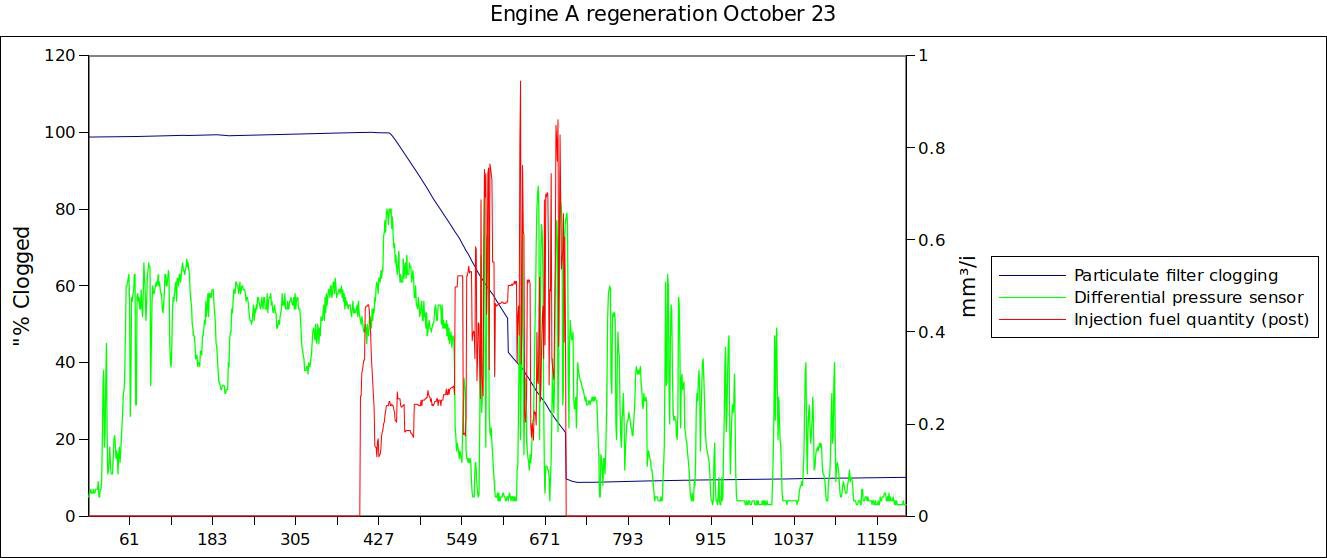
Below is a screen grab of an active regen for my vehicle:

Duration about 450 seconds and average temperature of 625C.

1761779867113.png
 
@deejays thanks for all that. My assumption that zero = shut was based on the fact that just after the throttle valve failed and the van went into limp mode I was actively recording with MES and the throttle valve recorded a value of zero throughout with a fault code that the throttle valve was stuck closed, thus choking the engine. But I guess too much air would be as just as problematic as too little air?

This is perhaps somewhat immaterial for me now as the new valve opens differently and the van runs better as a result.

Still doesn't explain soot in the exhaust though, so I'm still expecting to have to replace the DPF and discect the LPEGR cooler until its performance tells me otherwise!

I'll post again once the DPF has done its thing (or not!). Fingers crossed!!!!!!!
 
I guess if you think about it, then the Italian design engineers got it right. It is a throttle and if the throttle plate is at 100%, then it is fully 100% throttling the intake, and inversely if it is at 0%, then the inlet is not throttled. It is diesel, not petrol.
 
Hi @Dancingbear , seems your issue may have been fixed with the new throttle body. It is strange how FIAT wish to lead us all into confusion. 0% throttle valve opening actually means wide open, and 100% means it is fully shut (opposite to what you have stated and quite correctly would be assumed to be the case). So, the old throttle body was always closed more than it should have been which would reduce the fresh air flow overall, possibly leading to a rich mixture and increased soot. Makes sense.

If you are now happy with how the vehicle drives, then job done. But I would keep an eye on the active DPF regenerations with MES at least for the next two or three cycles just to be sure all is OK in that department.

If you are using a Bluetooth interface, then you could easily monitor when the DPF regen is due to occur conveniently with an android phone and the free version of the following app:

https://play.google.com/store/apps/details?id=com.kapron.ap.dpfmonitor&hl=en_AU

This is much more convenient that hooking up a PC with MES all the time. Then, when it is getting near 100%, switch over to the PC with MES and run the Template 0 as per my revised templates list:

https://www.fiatforum.com/guides/re...ines-for-blocking-lpegr-cooler-diagnosis.991/

Below is a screen grab of an active regen for my vehicle:

Duration about 450 seconds and average temperature of 625C.

View attachment 475841
Any suggestions for an iOS version of that app? I've tried car scanner but I can't access my DPF data? Cheers
 
Any suggestions for an iOS version of that app? I've tried car scanner but I can't access my DPF data? Cheers

There is an iOS version of multi ECU scan. However it's a subscription at some 60 euros per year.

Car Scanner can usually get at least some data out if you try all the Ducato profiles one by one.

I use it with a profile that tells me the soot load (regen occurring normally at 130% of that parameter), temperature, and when the regen is happening (DPF regen in progress, takes many values, regen is happening when it's an odd number eg. 17).
 
Last edited:
Back
Top