Technical  First drive and a problem

Currently reading:
Technical  First drive and a problem

GBGraham

Member
Joined
Mar 19, 2026
Messages
95
Points
78
Location
Epidavros
Today was the cars first road test since I got the car and I only did about 5kms. When I got home and on tick over I could hear a banging from under the bonnet, the temperature was high at 105 but that is no where near the red, I just expected the fan not to be working when I lifted the bonnet but that was functioning just fine.
Yes it was hot and the top hoses were under fair pressure and to save any mishaps I left it for 15mins with the fan running and when I went back to the car it had sucked the hoses inward to nearly flat. Nothing was happening regarding the expansion tank and no great event when I removed the radiator cap. After an hour I topped up the radiator but it only took about a litre, I've gone no further for today.
I have only ever had a similar problem on my Jaguar XJ8 with premature boiling and hoses being sucked in flat and it was due to the plastic vanes on the water pump failing and this was a manufacturing fault, no new ones available so I located a s/h pump.
Now I can't see a 55y.o. having plastic vanes but has anyone else had any similar problems with the water pumps?
The other question is, are the gauges normally supplied via a charging relay as mine only read when the engine is running and charging?
 
The cooling system on the 124's is a sealed system i.e. expansion of coolant causes excess to travel to the plastic expansion tank, as system cools down, coolant is drawn back from the expansion tank to keep the radiator full. Here's an explanation of how such a system operates, including the radiator cap, your cap is the type (b) closed construction type in Fig. 5.18 below:-

Scan_20260510.png
Scan_20260510 (2).png


Top rad hoses will feel to be under pressure as engine heats up but not excessively so. The rad cap should bleed off excess pressure by opening and allowing some coolant to flow to the expansion tank.

Hoses being sucked flat after a hot engine has cooled down suggests either the recuperation valve in the rad. cap isn't opening (to allow coolant to return from the expansion tank) or there is a blockage in the exp. tank line or tank.

It's also possible that an incorrect rad. cap has been fitted, the cap must incorporate a recuperation valve. The cap opening pressure should be 15 lbs and iirc there are 2 types - long or short, depending on the depth of the filler neck.
For those not familiar with the term 'recuperation valve' - if you look at the bottom of the rad cap i.e. the part that goes into the rad. filler hole, the recuperation valve is a little spring loaded metal disc with it's own rubber seal situated in the centre of the cap main seal. To check if this has stuck, it can be prised open gently using e.g. a small screwdriver, if using a pick, be careful not to damage the rubber seal.

In my experience, the hose/plastic line from the rad. to the expansion tank doesn't usually give trouble but the tank itself can. The hose attaches to a plastic stub on the tank, inside this stub is a metal pipe protruding up into the tank (it reaches approx. 1/2 way up inside the tank, visible with the exp. tank cap removed. This metal pipe has several holes along it's length and it's upper end is swaged closed. This pipe is mild steel and corrodes, badly if system is run without corrosion inhibitors (e.g. no antifreeze or very old a/freeze). This metal pipe, if badly rusted, can prevent the flow of coolant from the radiator to the exp. tank or from the exp. tank back to the rad. This also, could explain the symptoms you experienced with the rad. hoses.

The rad shouldn't need to be topped up in normal use, any topping up is done via the expansion tank, the correct level is the exp. tank is 7 cms above the min. level mark (situated below the mounting strap) on the tank with the system cold. The level will rise as the engine gets hot and may rise noticeably immediately after stopping the engine.

I've never seen one of these Fiats having a water pump with a plastic impeller, they've all been cast metal. It used to be possible to rebuild these pumps,
Fiat supplied a special tool to remove the impeller (it had an internal thread for it's removal), and the seal and bearing with shaft were readily available. (afaik, the same spring-loaded carbon ring seal is used on some other older Fiats and some older Ferrari models).

I'd suggest:-
1) Check rad cap fitted is correct and that recuperation valve is functioning.
2) Check hose/plastic line between rad. and expansion tank is clear of any blockage.

3) Check metal pipe inside exp. tank hasn't become blocked/collapsed.
If this metal pipe is badly rusted (it may even have broken off or been removed) it can be carefully removed from the plastic tank stub and replaced with another pipe, closed off at it's upper end and with a series of holes drilled along it's length - I've used Kunifer (copper/nickel) tubing, iirc it's possibly 8mm outside diameter (early 124 Coupes/Spiders used a much larger pipe on the expansion tank). The metal pipe can also be omitted but it's presence prevents the tank plastic stub collapsing when the hose clip is tightened.
These plastic tanks are usually discoloured internally by rusty coolant - most of this can be removed by removing the tank, inserting some coarse sand + gravel + detergent + water and shaking the tank to remove the rusty stain. This is well worth doing as you can then check the coolant level without removing the cap, + it looks nice.

4) To fill the cooling system, with engine cold, turn heater control on (lever on centre console), remove rad. cap, fill the rad. to the neck, refit rad. cap, fill exp. tank to the correct level (7 cms above the min. mark), start engine and allow to warm up until the rad. fan kicks in while keeping a check on the level in the expansion tank and topping up if the level drops. When finished, refit exp. tank cap. Re-check level in ex. tank when engine has cooled down.
You can if you wish, occasionally squeeze the bottom hose as the engine is warming up and blip the throttle to try to dislodge any air-locks that may be present, but be careful, remember the electric fan may kick in without warning. Don't be surprised if you see the bottom rad. hose collapsing slightly when you blip the throttle as it's on the suction side of the water pump.

I don't think at this stage that there's anything amiss with your thermostat, but you might check that the rad is heating up normally, i.e. cool initially then top of rad. rapidly heats up as thermostat opens (observe water temp. gauge, thermostat should open @ 87*C, 189*F. ). This check is for a thermostat in the cyl. head, if your car has a bypass type thermostat (connected into bottom rad hose) then the procedure for checking may be different?

Afaik, the gauges should all show readings when the ignition is switched on, the engine doesn't have to be running. (the gauges are fed from fuses that are live with ignition on. Maybe someone has been playing around with the wiring? Or was it you who mentioned he had fitted a Lada ignition switch?

There are 2 temp. sender units screwed into the cylinder head, the forward one triggers the high temp. warning light, the rear sender operates the water temp. gauge - earthing the wire to the front sender should light the high temp w/light, earthing the rear sender wire should send the temp gauge to max on scale. Obviously, any chafing of these wires can result in accidental earthing and therefore false high temp. w/light or high gauge readings.
Iirc, on some models, earthing the front sender wire doesn't just light the warning light but also sends the temp. gauge to max on scale - so, if the gauge suddenly reads max, at the same time as the warning light has come on, disconnect the front sender wire and see if temp. gauge drops to normal. (it may be just a failed front sender unit and not an engine overheat situation).
 
The cooling system on the 124's is a sealed system i.e. expansion of coolant causes excess to travel to the plastic expansion tank, as system cools down, coolant is drawn back from the expansion tank to keep the radiator full. Here's an explanation of how such a system operates, including the radiator cap, your cap is the type (b) closed construction type in Fig. 5.18 below:-

View attachment 487184View attachment 487185


Top rad hoses will feel to be under pressure as engine heats up but not excessively so. The rad cap should bleed off excess pressure by opening and allowing some coolant to flow to the expansion tank.

Hoses being sucked flat after a hot engine has cooled down suggests either the recuperation valve in the rad. cap isn't opening (to allow coolant to return from the expansion tank) or there is a blockage in the exp. tank line or tank.

It's also possible that an incorrect rad. cap has been fitted, the cap must incorporate a recuperation valve. The cap opening pressure should be 15 lbs and iirc there are 2 types - long or short, depending on the depth of the filler neck.
For those not familiar with the term 'recuperation valve' - if you look at the bottom of the rad cap i.e. the part that goes into the rad. filler hole, the recuperation valve is a little spring loaded metal disc with it's own rubber seal situated in the centre of the cap main seal. To check if this has stuck, it can be prised open gently using e.g. a small screwdriver, if using a pick, be careful not to damage the rubber seal.

In my experience, the hose/plastic line from the rad. to the expansion tank doesn't usually give trouble but the tank itself can. The hose attaches to a plastic stub on the tank, inside this stub is a metal pipe protruding up into the tank (it reaches approx. 1/2 way up inside the tank, visible with the exp. tank cap removed. This metal pipe has several holes along it's length and it's upper end is swaged closed. This pipe is mild steel and corrodes, badly if system is run without corrosion inhibitors (e.g. no antifreeze or very old a/freeze). This metal pipe, if badly rusted, can prevent the flow of coolant from the radiator to the exp. tank or from the exp. tank back to the rad. This also, could explain the symptoms you experienced with the rad. hoses.

The rad shouldn't need to be topped up in normal use, any topping up is done via the expansion tank, the correct level is the exp. tank is 7 cms above the min. level mark (situated below the mounting strap) on the tank with the system cold. The level will rise as the engine gets hot and may rise noticeably immediately after stopping the engine.

I've never seen one of these Fiats having a water pump with a plastic impeller, they've all been cast metal. It used to be possible to rebuild these pumps,
Fiat supplied a special tool to remove the impeller (it had an internal thread for it's removal), and the seal and bearing with shaft were readily available. (afaik, the same spring-loaded carbon ring seal is used on some other older Fiats and some older Ferrari models).

I'd suggest:-
1) Check rad cap fitted is correct and that recuperation valve is functioning.
2) Check hose/plastic line between rad. and expansion tank is clear of any blockage.

3) Check metal pipe inside exp. tank hasn't become blocked/collapsed.
If this metal pipe is badly rusted (it may even have broken off or been removed) it can be carefully removed from the plastic tank stub and replaced with another pipe, closed off at it's upper end and with a series of holes drilled along it's length - I've used Kunifer (copper/nickel) tubing, iirc it's possibly 8mm outside diameter (early 124 Coupes/Spiders used a much larger pipe on the expansion tank). The metal pipe can also be omitted but it's presence prevents the tank plastic stub collapsing when the hose clip is tightened.
These plastic tanks are usually discoloured internally by rusty coolant - most of this can be removed by removing the tank, inserting some coarse sand + gravel + detergent + water and shaking the tank to remove the rusty stain. This is well worth doing as you can then check the coolant level without removing the cap, + it looks nice.

4) To fill the cooling system, with engine cold, turn heater control on (lever on centre console), remove rad. cap, fill the rad. to the neck, refit rad. cap, fill exp. tank to the correct level (7 cms above the min. mark), start engine and allow to warm up until the rad. fan kicks in while keeping a check on the level in the expansion tank and topping up if the level drops. When finished, refit exp. tank cap. Re-check level in ex. tank when engine has cooled down.
You can if you wish, occasionally squeeze the bottom hose as the engine is warming up and blip the throttle to try to dislodge any air-locks that may be present, but be careful, remember the electric fan may kick in without warning. Don't be surprised if you see the bottom rad. hose collapsing slightly when you blip the throttle as it's on the suction side of the water pump.

I don't think at this stage that there's anything amiss with your thermostat, but you might check that the rad is heating up normally, i.e. cool initially then top of rad. rapidly heats up as thermostat opens (observe water temp. gauge, thermostat should open @ 87*C, 189*F. ). This check is for a thermostat in the cyl. head, if your car has a bypass type thermostat (connected into bottom rad hose) then the procedure for checking may be different?

Afaik, the gauges should all show readings when the ignition is switched on, the engine doesn't have to be running. (the gauges are fed from fuses that are live with ignition on. Maybe someone has been playing around with the wiring? Or was it you who mentioned he had fitted a Lada ignition switch?

There are 2 temp. sender units screwed into the cylinder head, the forward one triggers the high temp. warning light, the rear sender operates the water temp. gauge - earthing the wire to the front sender should light the high temp w/light, earthing the rear sender wire should send the temp gauge to max on scale. Obviously, any chafing of these wires can result in accidental earthing and therefore false high temp. w/light or high gauge readings.
Iirc, on some models, earthing the front sender wire doesn't just light the warning light but also sends the temp. gauge to max on scale - so, if the gauge suddenly reads max, at the same time as the warning light has come on, disconnect the front sender wire and see if temp. gauge drops to normal. (it may be just a failed front sender unit and not an engine overheat situation).
Thanks so much once again with such a detailed and explained information. Remember this car has been stood for 4/5 years so I knew I probably was to have problems because of such issues as this which was obviously replaced with a new one. . . . .
Thermostat WhatsApp Image 2026-05-11 at 08.59.48.jpeg
The Tee piece that connects the top hoses and it's connecting housing was also blocked. All was cleared and cleaned, engine and radiator flushed but I must admit I didn't pay any attention to the expansion tank or pipe work so this will be my first point of attack along with the radiator cap.
I can't find a 15lb cap advertised for the 124, the highest is 0.7bar (10lbs) 🤔
Obviously I will be reporting back with progress +/-
 
two things to check... make sure you have the thermostat fitted in the correct orientation, it's easy to fit it wrong.... they come in a few different types and I've seen plenty fitted "backwards" that caused an issue.

the other thing is with a spyder, the radiator is lower than the highest point of the engine... simple way is raise the front of the car to lift the radiator cap higher when filling / bleeding... and an even better way it to fit a "flushing T" in the heater hose at the back of the head, and then use this as a fill point whenever the cooling system has been drained off / opened up.

as usual you also need to bleed the heater circuit or a bubble of air gets trapped in there too

correct cap is 0.7 bar, pony up for an original IPRA short neck 0.7bar radiator cap, it will be a lot more than what the cheap chinese caps from the local parts shop will sell you, but it's cheap insurance against cooling system issues. Some Alfa's use the same cap, you may have more luck in the UK finding one at an alfa specialist

gauges should function at ignition on position without the engine actually running

SteveC
 
Last edited:
------------
I can't find a 15lb cap advertised for the 124, the highest is 0.7bar (10lbs) 🤔
Obviously I will be reporting back with progress +/-
Apologies for stating it was a15 lb cap, I was wrong and so was my Haynes manual! It should of course be a 10 lb (0.7 bar) cap as correctly pointed out by @thefiatfactory. Here's a couple of pics showing the long/tall and short rad caps - Your car being a CC Coupe probably takes the (1st) short version :-

Screenshot_12-5-2026_01319_www.riauto.ch.jpeg


Screenshot_12-5-2026_0156_www.riauto.ch.jpeg

NOTE :- These pics are from https://riauto.ch a Swiss Co. parts supplier incl. much for the 124 Coupe/Spider. I don't know if @GBGraham can conveniently order from this supplier but it's a site worth looking at, as they provide excellent parts diagrams of each sub-assembly.

I've seen quite a number of 124 Coupes resurrected after being out of use for a number of years and with cooling systems clogged up just like yours, some have experienced head gasket failure shortly after being put back into use - just something to watch out for (especially in a hot climate). Also, have you replaced the timing belt?
 
Last edited:
Apologies for stating it was a15 lb cap, I was wrong and so was my Haynes manual! It should of course be a 10 lb (0.7 bar) cap as correctly pointed out by @thefiatfactory. Here's a couple of pics showing the long/tall and short rad caps - Your car being a CC Coupe probably takes the (1st) short version :-

View attachment 487233

View attachment 487234
NOTE :- These pics are from https://riauto.ch a Swiss Co. parts supplier incl. much for the 124 Coupe/Spider. I don't know if @GBGraham can conveniently order from this supplier but it's a site worth looking at, as they provide excellent parts diagrams of each sub-assembly.

I've seen quite a number of 124 Coupes resurrected after being out of use for a number of years and with cooling systems clogged up just like yours, some have experienced head gasket failure shortly after being put back into use - just something to watch out for (especially in a hot climate). Also, have you replaced the timing belt?
They seem to have a very comprehensive stock and if I don't get clobbered for price, tax or carriage I will use them. I knew after 5 years of being stood that I would expect have problems, with fuel, water and oil seals, as of today we seem to be running fine, temperature showing just short of 90 degs to just a little over 90degs and the fan cuts in. As before after flushing I just filled up and went, this time I took time in filling with the jacked up and bleeding the system, removing and cleaning the expansion tank and line, then with extensive static running,
I now feel confident for it's next road trial🤞but I am waiting for the Historic plates to come through and then I need to get a Ministry test, the car is insured though.
No I haven't done anything with the belt yet, this is because I am not happy with the way the belt is running on I assume non standard and probably lightened pulleys, the belt just doesn't seem central on the pulleys for my liking but this is something I don't want to get involved with, I'm going to look for someone that is in the know and sort the issue and do the belt.
If you expand this picture you can see the lefthand belt is a couple of mm overhang on the pulley, I don't find this to be correct, your thought guys🤔

cam belt WhatsApp Image 2026-05-12 at 19.27.49.jpeg
 
They seem to have a very comprehensive stock and if I don't get clobbered for price, tax or carriage I will use them. I knew after 5 years of being stood that I would expect have problems, with fuel, water and oil seals, as of today we seem to be running fine, temperature showing just short of 90 degs to just a little over 90degs and the fan cuts in. As before after flushing I just filled up and went, this time I took time in filling with the jacked up and bleeding the system, removing and cleaning the expansion tank and line, then with extensive static running,
I now feel confident for it's next road trial🤞but I am waiting for the Historic plates to come through and then I need to get a Ministry test, the car is insured though.

No I haven't done anything with the belt yet, this is because I am not happy with the way the belt is running on I assume non standard and probably lightened pulleys, the belt just doesn't seem central on the pulleys for my liking but this is something I don't want to get involved with, I'm going to look for someone that is in the know and sort the issue and do the belt.
If you expand this picture you can see the lefthand belt is a couple of mm overhang on the pulley, I don't find this to be correct, your thought guys🤔

View attachment 487277

Your latest coolant temp. readings seem fine.

I've never had to jack up any 124 COUPE in order to bleed any air from the cooling system - blipping the throttle a few times will usually clear any air from the heater feed hose on the cyl. head (the upper curve on this heater hose is the highest point on a COUPE engine. The SPIDER may be different. I have seen fill/bleed T pieces being advertised for the Spider but my attitude is, if it was needed, the Fiat engineers would have fitted one, if they didn't, then it wasn't needed. At this stage of my life, I'm quite cynical about claims, made by people selling things, 'that you need one'. I would concede that a simple bleed screw fitting might help in bleeding air but I don't see any need to have to fill the system through the heater feed hose.

The belt shouldn't overhang any of the pulleys - iirc the belt runs against the retaining ring/flange on the inlet cam pulley and away from the retaining flange on the exhaust cam pulley i.e edge of belt is almost at edge of pulley (next to the cam-box) but without any overhang.
I tried enlarging your pic. but it just became more blurred and the cam belt/pulley area was too dark.

Incidentally, which engine is in your car, I thought you said it was a 124CC 1600cc.? Iirc, the 124CC engines (1592 and 1756cc) used 'plastic type' cam pulleys with a metal centre, the earlier engines (1438 and 1608cc) had solid metal pulleys. These later 'plastic' pulleys could suffer from cracking or the metal centres becoming loose, experts recommended not to use these later pulleys on competition engines or for sustained high rpm usage.

I wouldn't trust any old timing belt on an interference type engine such as is in the 124 Coupe. Have you at least inspected the belt for signs of deterioration - especially cracking? Any play/rock in the tensioner bearing? End-float in camshafts? Belt tension (new belt) - with engine cold, it should be just about possible to twist the long run of the belt (i.e. section of belt between inlet cam pulley and auxiliary drive pulley - that's the one below the inlet cam pulley) through 90* with firm finger pressure. This possible 90* movement will be reduced as engine warms up. An old belt will likely be a little looser.

Changing the timing belt is not difficult, front crank pulley nut (38mm or 1- 1/2"AF) doesn't need to be removed unless you need to change the front crank oil seal, timing marks are obvious, no special locking/ alignment tools needed, tensioner is spring loaded so no belt tension gauge needed. Lots of how-to-videos are available, the procedure has been covered here on many occasions and successfully completed by members who had never changed a t/belt before.
But obviously, it's your decision as regards doing the job yourself or engaging someone to do it (can you be confident they'll do it correctly?).
 
Last edited:
Your latest coolant temp. readings seem fine.

I've never had to jack up any 124 COUPE in order to bleed any air from the cooling system - blipping the throttle a few times will usually clear any air from the heater feed hose on the cyl. head (the upper curve on this heater hose is the highest point on a COUPE engine. The SPIDER may be different. I have seen fill/bleed T pieces being advertised for the Spider but my attitude is, if it was needed, the Fiat engineers would have fitted one, if they didn't, then it wasn't needed. At this stage of my life, I'm quite cynical about claims, made by people selling things, 'that you need one'. I would concede that a simple bleed screw fitting might help in bleeding air but I don't see any need to have to fill the system through the heater feed hose.

The belt shouldn't overhang any of the pulleys - iirc the belt runs against the retaining ring/flange on the inlet cam pulley and away from the retaining flange on the exhaust cam pulley i.e edge of belt is almost at edge of pulley (next to the cam-box) but without any overhang.
I tried enlarging your pic. but it just became more blurred and the cam belt/pulley area was too dark.

Incidentally, which engine is in your car, I thought you said it was a 124CC 1600cc.? Iirc, the 124CC engines (1592 and 1756cc) used 'plastic type' cam pulleys with a metal centre, the earlier engines (1438 and 1608cc) had solid metal pulleys. These later 'plastic' pulleys could suffer from cracking or the metal centres becoming loose, experts recommended not to use these later pulleys on competition engines or for sustained high rpm usage.

I wouldn't trust any old timing belt on an interference type engine such as is in the 124 Coupe. Have you at least inspected the belt for signs of deterioration - especially cracking? Any play/rock in the tensioner bearing? End-float in camshafts? Belt tension (new belt) - with engine cold, it should be just about possible to twist the long run of the belt (i.e. section of belt between inlet cam pulley and auxiliary drive pulley - that's the one below the inlet cam pulley) through 90* with firm finger pressure. This possible 90* movement will be reduced as engine warms up. An old belt will likely be a little looser.

Changing the timing belt is not difficult, front crank pulley nut (38mm or 1- 1/2"AF) doesn't need to be removed unless you need to change the front crank oil seal, timing marks are obvious, no special locking/ alignment tools needed, tensioner is spring loaded so no belt tension gauge needed. Lots of how-to-videos are available, the procedure has been covered here on many occasions and successfully completed by members who had never changed a t/belt before.
But obviously, it's your decision as regards doing the job yourself or engaging someone to do it (can you be confident they'll do it correctly?).
I can't argue with your knowledge but I did come across it two or three times in articles/Youtube to jack up the car, for me it sort of made sense and appears to have had a result.
My engine is the 1608cc but they are definitely not solid pulley's and I have attached some pics. I also have no idea at all of what they are, why they don't line up and what to do to remedy it. These reasons are why I am reluctant to start to tackle the work myself otherwise I would change the timing belt myself.


WhatsApp Image 2026-05-13 at 13.52.49.jpegWhatsApp Image 2026-05-13 at 13.52.48.jpegWhatsApp Image 2026-05-13 at 13.52.46.jpegWhatsApp Image 2026-05-13 at 13.52.45 (1).jpegWhatsApp Image 2026-05-13 at 13.52.39.jpegWhatsApp Image 2026-05-13 at 13.52.38.jpeg
 

Attachments

  • WhatsApp Image 2026-05-13 at 13.52.37.jpeg
    WhatsApp Image 2026-05-13 at 13.52.37.jpeg
    145.2 KB · Views: 18
  • WhatsApp Image 2026-05-13 at 12.58.26.jpeg
    WhatsApp Image 2026-05-13 at 12.58.26.jpeg
    148.2 KB · Views: 19
I can't argue with your knowledge but I did come across it two or three times in articles/Youtube to jack up the car, for me it sort of made sense and appears to have had a result.
My engine is the 1608cc but they are definitely not solid pulley's and I have attached some pics. I also have no idea at all of what they are, why they don't line up and what to do to remedy it. These reasons are why I am reluctant to start to tackle the work myself otherwise I would change the timing belt myself.


View attachment 487307View attachment 487308View attachment 487309View attachment 487310View attachment 487311View attachment 487312
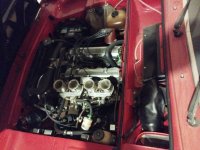
I was a bit suspicious of your engine (pic in post #6) when I saw the 2 twin choke downdraft carbs,
(I think you mentioned these carbs in an earlier thread but I have difficulty in remembering who has which year of car, whether it's a Coupe or Spider and which engine they have installed, unless they state these things in each new thread, not just in their 1st thread)
Then I noticed the cam covers had been polished - as standard, they're a rough sand-cast finish so I thought someone has expended considerable time/effort (or money?) to do this. I couldn't see much of the cam belt pulleys.

Your latest pics above suggest a different story - those pulleys are aftermarket one's that are adjustable so that the valve timing can be set accurately (afaik, our American friends call this 'dialling in' a cam). Here's some, similar to your's, that are available from Vick Auto in the U.S. :-

Screenshot_13-5-2026_231423_www.vickauto.com.jpeg


I know pics can sometimes give a distorted view of things e.g. whether something is straight or correctly aligned, but some of these pics 'seem' to show the timing belt is running misaligned between the inlet cam pulley and the one below (auxiliary drive pulley), also seems to be running off-centre on the tensioner bearing, in addition to being incorrectly aligned on the 2 top pulleys (In. + Ex.).
Here's a pic that shows used top pulleys with the belt removed - you can see the belt runs close (with a small gap remaining) to the flange on the inlet cam pulley (nearest in pic) and a little in from the rear edge of the exhaust cam pulley (farthest in pic), witnessed by the remaining film of dirt each side of the belt run. This is the normal belt pattern on the pulleys.

Scan_20260513 (7).png


I'm wondering if your engine has been modified internally e.g. different/re-profiled cams necessitating the use of adjustable cam pulleys to set the valve timing? On the 1608 cc engine there is a valve timing indicator bracket attached to the top coolant outlet on the cyl. head, there is such a bracket on your engine but it seems to have had the outer tips (that align with holes in standard pulleys for timing purposes) trimmed back? Are there any timing marks on the adjustable pulleys? The cam belt cover incorporates timing marks near its lower end that can be aligned with the mark/notch in the crank pulley when checking valve or ignition timing but you don't yet have a belt cover fitted (I recall you saying you were working towards this).

To overcome this problem of the timing belt being misaligned on the cam pulleys, you could revert to standard i.e. non-adjustable pulleys, the one's fitted seem to be incorrect for your engine - but you'd need to verify if stock or modified cams are installed in your engine e.g. by checking the valve lift and timing figures and comparing them with the factory figures. If modified cams are fitted, you might need the adjustable pulleys.

Or it might be possible to machine a little from the inside face of the adjustable pulleys where they fit against the camshaft noses? This would move the pulleys towards the engine and hopefully result in the belt now running correctly on the pulleys. This would probably be the quickest/cheapest solution. If there are no timing marks on the current adjustable pulleys, you'd be well advised to make some reference marks yourself before removing them.

Personally, I wouldn't continue to run this engine until I was satisfied with the way the belt was running, certainly wouldn't do any long drives.
The timing belt looks to be in good condition, probably wasn't in use for long, but I wouldn't trust an aged belt, just in case...

Remember, if you decide to refit a timing belt cover, you'll have to disturb the cooling system (top outlet from cyl. head has to be disconnected). To change the belt in the future, the belt cover has to be removed, so cooling system opened again. I'd fit a new belt now and then the belt cover/cooling system won't have to be disturbed again. (having first resolved the issue with timing belt alignment of course).
 
Last edited:
Enlarging your pics, I'm now wondering if instead of machining the back (recess) of those adjustable pulleys where they fit on the noses of the cams, might it be possible to separate the adj. pulley and place spacers/a shim plate between the 2 halves (front and rear parts) to move the toothed outer portion more towards the cam boxes in order to correct the belt positioning on the pulleys?

You could also remove the dowel pins from the cams, machine a little from the nose of the cams, then refit the dowel pins and the pulleys but this would entail removing the camboxes and cams from the engine (which can be done in situ), but this sounds like too much work.
 
Thanks for your interest and thoughts and here is what I know. The car has had reprofiled/high lift camshafts and unfortunately the previous owner doesn't speak any English and translating technical details is a nightmare. I am meeting with him on Sunday to get some spares that belong to the car so I will try to find out more, like who did the engine work etc.
For me looking at the problem, if the righthand pulley could be shimmed out by 5mm (which is a hell of lot shims in my book) this would align belt to a correct position on all the other pulleys. The spacing between the camshaft journal housings seem to be the same, I can't get anything in that I have to give an accurate measurement but I would say the spacing could be less than a millimetre.
When the engine is running the belt is so easily realigned with the lightest of touch using the shaft of a pozidrive but it just returns when removed, other than this I can't imagine what would make it out of line unless the tension roller is somehow out of line?
Making timing marks to the pulleys and block are on my list when I come to change the belt
 

Attachments

  • WhatsApp Image 2026-05-14 at 09.47.42.jpeg
    WhatsApp Image 2026-05-14 at 09.47.42.jpeg
    226 KB · Views: 14
  • WhatsApp Image 2026-05-14 at 09.47.43.jpeg
    WhatsApp Image 2026-05-14 at 09.47.43.jpeg
    220.3 KB · Views: 16
Going back to the running hot at the beginning of this post, if the muck you had in hose at photo in #3 is the same inside the cooling tubes in the radiator then whilst engine may run normal when in workshop or idling, as soon as driven harder especially if engine tuned then radiator will find it hard to get rid of the heat.
The hoses collapsing on cooling down and water not replenishing from expansion tank does point to the little spring loaded flap valve disc in centre of lower part of the rad cap being stuck closed. If cap working correctly after a run and cooled down the water level under the pressure cap should be right at the top if system all good.:)
There was a post elsewhere on Forum with cambelt running off line I think due to the tensioner being not located properly.
 
Going back to the running hot at the beginning of this post, if the muck you had in hose at photo in #3 is the same inside the cooling tubes in the radiator thenhany whilst engine may run normal when in workshop or i idling, as soon as driven harder especially if engine tuned then radiator will find it hard to get rid of the heat.
The hoses collapsing on cooling down and water not replenishing from expansion tank does point to the little spring loaded flap valve disc in centre of lower part of the rad cap being stuck closed. If cap working correctly after a run and cooled down the water level under the pressure cap should be right at the top if system all good.:)
There was a post elsewhere on Forum with cambelt running off line I think due to the tensioner being not located properly.
Thanks for this, I did give both the engine and radiator a really good flush and l didn't see anything spectacular leave the system. I did also replace the radiator cap as someone advised.
I will try and find the thread later as I'm facedown in physio getting electrocuted
 
I have checked back #bugsymike but the only one I could find was nonconclusive as the poster couldn't be bothered coming back with a conclusion even with another member politely asking for him to do so, very annoying in such cases.
 
I have checked back #bugsymike but the only one I could find was nonconclusive as the poster couldn't be bothered coming back with a conclusion even with another member politely asking for him to do so, very annoying in such cases.
Sadly that does happen, so no help for others trying to learn about an issue.
Re the cam belt running off line issue, I think the post was about where the tensioner has a single securing bolt but the back of it is located on a peg and they missed the peg so it pushed the tension pulley bearing off line. Probably not the issue in your case as you are not getting the belt running hard against the guides on the sprockets which would soon show wear on the belt I would have thought. I have seen mechanics run an engine without the fan belt pulley on crank which on certain engines is the guide and it was only luck that they stopped the engine before the belt walked off the crank sprocket.:)
Your cam sprockets have the guides where one stops it in one direction from running off and the other works the opposite way so appear to be doing the job. I do notice there looks to be some black rubber? deposit on the cam sprockets where the teeth engage,. Any idea why that should be there?
 
The way I see the off line scenario, the distance from the sprocket edges (including the crank sprocket and adjuster pulley) on each are the same, they just all need to move towards the front of the car by 5mm. What is throwing this belt out of line I just haven't got to the bottom of yet but I will wait until I fit the new belt and see what happens and go from there.
Yes there is some black deposits on the wheels, there is 5 years of debris on the engine so again I will wait until I change the cambelt but this does look like it could be belt compound.
 
The way I see the off line scenario, the distance from the sprocket edges (including the crank sprocket and adjuster pulley) on each are the same, they just all need to move towards the front of the car by 5mm. What is throwing this belt out of line I just haven't got to the bottom of yet but I will wait until I fit the new belt and see what happens and go from there.
Yes there is some black deposits on the wheels, there is 5 years of debris on the engine so again I will wait until I change the cambelt but this does look like it could be belt compound.
If the engine was modified previously I wonder if the cam belt is narrower than standard one for some reason.
Hopefully you can overcome the language barrier when you chat to previous owner.:)
 
If the engine was modified previously I wonder if the cam belt is narrower than standard one for some reason.
Hopefully you can overcome the language barrier when you chat to previous owner.:)
Unfortunately that is going to happen, I have tried going down this route on messenger yesterday and he has nothing on the tuning of the engine. Apparently his brother who is a life long auto engineer and did all the work but he tells me they haven't spoken for years, probably fell out over the car 🤔 so apart from what assistance I get on here I'm on my own again;)
 
Unfortunately that is going to happen, I have tried going down this route on messenger yesterday and he has nothing on the tuning of the engine. Apparently his brother who is a life long auto engineer and did all the work but he tells me they haven't spoken for years, probably fell out over the car 🤔 so apart from what assistance I get on here I'm on my own again;)
No chance of contacting the brother and "sweet talking" him or does he thing the car is rightfully his?:(
 
Back
Top