

You are using an out of date browser. It may not display this or other websites correctly.
You should upgrade or use an alternative browser.
You should upgrade or use an alternative browser.
Battery fires - Jeep
- Thread starter Zardo
- Start date
Currently reading:
Battery fires - Jeep

Every lithium ion battery has the potential to fail like this, whether a single AA cell in a small torch, or thousands of them together in a vehicle battery. A fault in manufacturing can cause this, maybe not immediately, but the clock is ticking from day one. As the battery charges and discharges, ions pass through the separator to the opposite electrode, and back during charging. Just like any battery. Some, apparently, don't make it back. We are used to lead acid batteries in our cars failing after several years, and if opened up, we will find debris collected at the bottom, or deposits on one plate preventing cthe normal chemical reaction. In a normal car battery, it loses power, and gives up. Many lithium ion batteries will die the same way, as experienced as our phne batteries gently give up. But, some of the non-returned ions can build up on the electrode, causing little peaks. Often we will find swollen batteries, particularly in laptops and phones. If that peak pierces the separator, it can just kill that cell, or it can cause a short, which creates heat. The temperature at which lithium ion will ignite is arouond 80 degrees celcius, not particularly hot. Then the gassing occurs, and if not able to escape, the flammable gas can explode. That risk is with each of the thousand or so cells in an electric car battery. Our phones can have batteries rated at 5-7000mAh, and when these burn there is a lot of energy to release, but throwing the thing out onto the concrete patio will usually let it burn out without much damage or other risk. When an EV has a 80-100kW battery, the energy stored is enormous. Think how long it takes you to use 100kW in your home. As we can see, even a company like Samsung can have manufacturing defects in their batteries. What risk from the cheaper Chinese manufacturers.
Once a Li-ion battery is burning, there's no stopping it. The chemical process creates its own oxygen, it burns at 2500 degC, so pouring water on only helps contain it, not put it out. The temp will melt the reinforcing steel in concrete, hence building collapses. As a comparison, petrol burns at around 850 degC, and diesel, if you can get it lit, at around 650 degC. Simple in comparison for the fire service to manage.
If it wasn't for the mad push to electrify everything, I thin health & safety might have banned such large Li-ion batteries. For me, a power tool battery is quite big enough, thank you.
Now the challenge is parking at supermarkets, at least 15m from an EV or hybrid.
Once a Li-ion battery is burning, there's no stopping it. The chemical process creates its own oxygen, it burns at 2500 degC, so pouring water on only helps contain it, not put it out. The temp will melt the reinforcing steel in concrete, hence building collapses. As a comparison, petrol burns at around 850 degC, and diesel, if you can get it lit, at around 650 degC. Simple in comparison for the fire service to manage.
If it wasn't for the mad push to electrify everything, I thin health & safety might have banned such large Li-ion batteries. For me, a power tool battery is quite big enough, thank you.
Now the challenge is parking at supermarkets, at least 15m from an EV or hybrid.
A few weeks ago in England near Exeter a car transporter truck carrying electric cars caught fire on the M5 . I think the fire originated in one of the cars. Many fire stations were invovled and the M5 was closed in both directions.
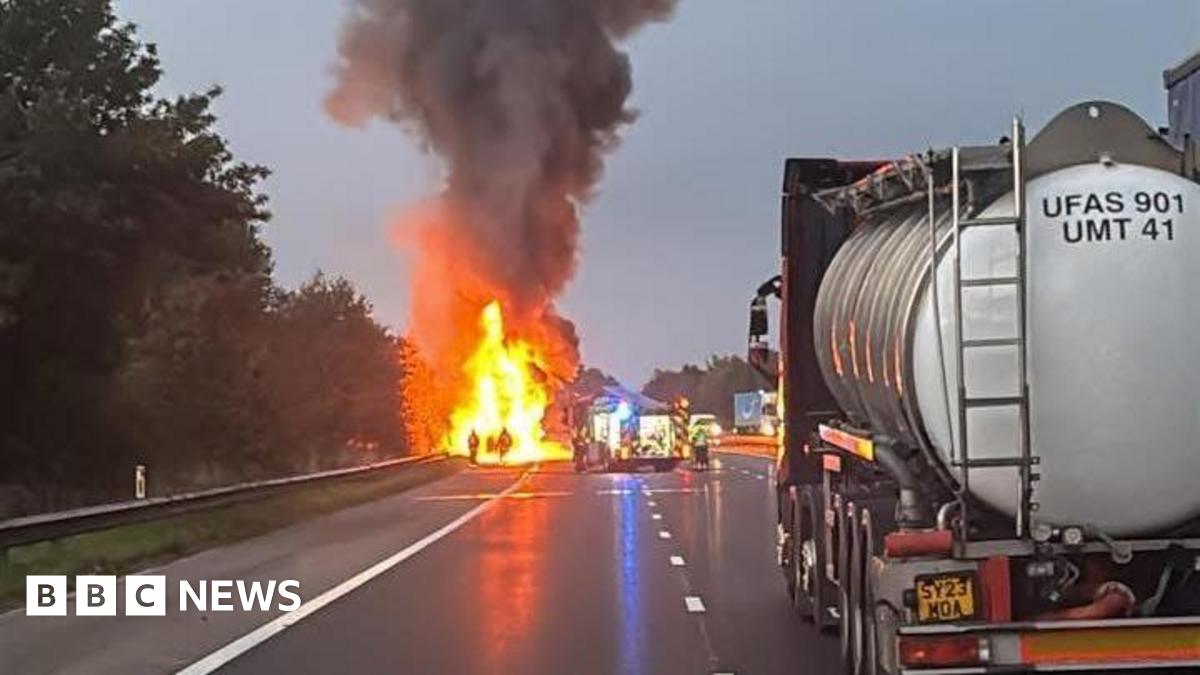
 www.bbc.co.uk
One side of mway shut 4hours other side shut 12 hours.
Major incident declared on M5 after car transporter fire
Nine electric vehicles catch fire in the southbound lanes of the M5 near Cullompton.
www.bbc.co.uk
One side of mway shut 4hours other side shut 12 hours.

The Panda Nut
Nutty about Pandas Infected by Panda virus and OPD


One side of mway shut 4hours other side shut 12 hours.
Thats progress for you LOL
Thats progress for you LOL

Er not quiteA few weeks ago in England near Exeter a car transporter truck carrying electric cars caught fire on the M5 . I think the fire originated in one of the cars. Many fire stations were invovled and the M5 was closed in both directions.
Major incident declared on M5 after car transporter fire
Nine electric vehicles catch fire in the southbound lanes of the M5 near Cullompton.
One side of mway shut 4hours other side shut 12 hours.
The fire started in the trailer, AIUI the axle overheated, a hydraulic line split and fed the fire.
Nothing to do with the EV apart from the fact they burnt just like an ICE car would.
EV are now bring built with LifePo4 batteries that don't burn unlike earlier Li-ion batteries
Not all EVs are using LifePo4. I thing the LifePo still burn, they are just less likely to self-combust. But like all EVs, once burning, are hotter than an ICE car, and more difficult to extinguish.Er not quite
The fire started in the trailer, AIUI the axle overheated, a hydraulic line split and fed the fire.
Nothing to do with the EV apart from the fact they burnt just like an ICE car would.
EV are now bring built with LifePo4 batteries that don't burn unlike earlier Li-ion batteries
Whilst the transporter may have started it own fire, once it spread to the EVs, it made the situation much worse, and significantly longer to resume normal road operations.
shera2025
Member
smoking is dangerous for your health
Yikes, that’s worrying! I’ve heard a few stories about battery issues on some Jeeps, especially with older or aftermarket batteries. Could be due to bad wiring, corrosion, or a short somewhere. Definitely worth checking the connections and making sure everything’s tight and clean. If it’s been happening often, might be good to have an auto electrician take a look. Better safe than sorry!
Again not quiteNot all EVs are using LifePo4. I thing the LifePo still burn, they are just less likely to self-combust. But like all EVs, once burning, are hotter than an ICE car, and more difficult to extinguish.
Whilst the transporter may have started it own fire, once it spread to the EVs, it made the situation much worse, and significantly longer to resume normal road operations.
If you look at the pictures from after the fire the cars still look like cars, if the batteries had combusted then there would have been just a mess of metal due to the heat
LifePo4 do not burn, but can produce hydrogen if heated, there again a LA battery does the same if overcharged. I know of one instance of a fire on a on a boat that had LifePo4 batteries but the jury is still out as to the exact cause.
After a quick bit of research the cars on the transporter were BYD Atto 3 that use LifePo4 batteries so 100% the EV were not the cause of the fire.
Again not quite
If you look at the pictures from after the fire the cars still look like cars, if the batteries had combusted then there would have been just a mess of metal due to the heat
View attachment 476375
LifePo4 do not burn, but can produce hydrogen if heated, there again a LA battery does the same if overcharged. I know of one instance of a fire on a on a boat that had LifePo4 batteries but the jury is still out as to the exact cause.
Their batteries all combusted. Only the shells are left. Also there was a news article 5 days afterwards which states thermal runaway in one of the vehicles as the cause.
I didn't start this to disparage EV nor was the intention an ideological rant.
It's true that LifePo4 mainly gas out incredible quantities of toxic fumes when their cells are breached. But they also heat up and there is a fire hazard at all times in such an event.
and
for spontaneous combustion after the cell was mechanically breached, see min 13:30
Last edited:
The Panda Nut
Nutty about Pandas Infected by Panda virus and OPD
Not all EVs are using LifePo4. I thing the LifePo still burn, they are just less likely to self-combust. But like all EVs, once burning, are hotter than an ICE car, and more difficult to extinguish.
Whilst the transporter may have started it own fire, once it spread to the EVs, it made the situation much worse, and significantly longer to resume normal road operations.
Pandas on the top!! No batteries and much less to burn anyway. Better all round.
My main point with the fire on m5 is time taken to deal with the fire involving electric vehicles. Major motorway closed for 12 hours , many firefiighters and their equipment tied up with incident. The fire point of origin or battery chemistry is interesting but secondary.
Would it have been any quicker if they had been petrol vehicles? Petrol cars have been known to explode when on fire.My main point with the fire on m5 is time taken to deal with the fire involving electric vehicles. Major motorway closed for 12 hours , many firefiighters and their equipment tied up with incident. The fire point of origin or battery chemistry is interesting but secondary.


