Technical Thermostat engine vent - who needs it?

Currently reading:
Technical Thermostat engine vent - who needs it?

Joined
Mar 5, 2012
Messages
156
Points
32
Hi all, I was boiling up a couple of thermostats the other day to check their operation, and started wondering if I should even use one at all. I live in New Zealand. Sure, it gets a little cold in winter but nothing like Europe. We're talking only a very few days a year below say 10 degrees centigrade. On the other hand it gets warm for a long part of the year. When complete my 500D will be a toy (albeit am expensive one!) and I'm very unlikely to need or want to use it in the depths of winter. Therefore i don't need a heater and i'll always have time to let the oil get warm before reving the car. On that basis, since it's air cooled, I wonder if it might be best to ditch the thermostat and vent altogether and simply spill all that hot air out of the way right from start-up.

Keen to hear the collective wisdom on this.

Cheers Roger
 
Hi,

I have actually wondered the same thing. I always let the engine warm and drive the first km abit easily. Driving only at summertime when the temperature is always more than 10 degrees.
Don't know how big role the oil plays in this case. I used 20-50 Motul which is quite thick.
Harleys and Ducatis are also aircooled without this system.
 
Last edited:
Exactly. My guzzi is the same. You just need to take a little care when it is really cold. Given that the outcome of a failed thermostat or mechanical interference with the vent itself is a lot of hot air being kept close to the top end surely those of us who live in mild climates can do without?
Roger
 
Roger/Jake,
I went through this dilemma as well. When I bought my car the thermostat was missing and the one on the Niki that I bought for parts was inoperative.
I was told that even though I live in a very mild climate I should refit it so I bought all the parts for a new one and installed it when I rebuilt the engine. I remain unconvinced and was thinking of removing it for much the same reasons that you mentioned - I don't want it to jam in the shut position and overheat the engine and because the car is more a garage queen than an every day runner, it gets very little use, particularly in the dead of our Winter.
Also, from my motorbike days many years ago (air cooled Jap bikes), I like you, used to just let the engine warm while I put all my kit on and will do the same with the Fiat. I'm sure that in our mild climate the engine will attain operating temperature quite quickly.
I'll keep an eye on this thread to gauge the informed opinions.
Chris
PS: I also intend to fit an oil temperature gauge soon.
 

Attachments

  • Thermostat.jpg
    Thermostat.jpg
    119.8 KB · Views: 68
Last edited:
I have a different opinion. I think you need the thermostat because this gets the engine up to proper temperature at the correct rate. In an engine with dissimilar metals that expand at different rates, this is important.
Most engine wear occurs during the phase when the engine is cold. So getting the engine to the correct operating temperature, at the correct ramp rate (time) is important for wear. Also maintaining a specific temperature without a lot of variance is important too.
You probably would not consider taking the thermostat out of your water cooled engine. This is really no different. The cooling medium is air instead of water, but both need to be regulated.
The reason they are not on motorcycles is because of the lack of real estate, the weight involved in enclosing the engine in a steel shroud, and the fact that the engine is sitting out in the air stream, which the engine in the 500 is not.
The parts are not that expensive (nothing on this car is!). You could just replace everything with new components (as Chris did) and then not worry about it not working.
Just an opinion!
John
 
Last edited:
I was pleased to have all of my tackle in place this morning as it was cold enough to....... !!! you know the well known phrase. Car is parked outside and had not run it for a week so at about 4c below it started fine with ice inside & outside the windows. let it run for a few mins and it was as warm as toast inside and warms up a lot quicker than our modern Fiat.
 
The devil's advocate in me says that if Fiat could have ditched this part to save a bit of money in a car that was definitely built to a price, they would have done so. Because they included it, they must have had a reason. Maybe it's useful after all ???

Chris

PS: There are plenty of old water cooled bangers in the various car clubs in my area running around without thermostats - but they are just that, old bangers and not thoroughbred Italian masterpieces :D

PPS: It was 38degC (100degF) here yesterday - thermostat probably stayed open I guess.
But then I live in the sub-tropics - we don't get a lot of snow ...
 
Last edited:
Thanks all for your thoughts on this. In the end I decided that because I had bought a new thermostat, rezinced the retaining nut, powdercoated the cover etc etc I may as well use the darn system! Once assembled I tested by heating the thermostat with a heat gun. All seemed to be working well.

Just a word here though on not trusting a thermostat just because it opens fully in boiling water. I tested my old one and a new replacement side by side and got very different results, even though they are both rated to operate between 70 and 90 degrees C.

I work for a research company so was able to heat both thermostats in an accurate temperature controlled water bath in one of our labs. At 70 degrees neither part had noticeably started to expand. At 75 the new one started, and at about 83 the old one started. By 90 the new one was almost fully open but the old one only about half way. At 100 they were both fully open. I was less scientific when looking at response to cooling. I just lifted both out of the bath at the same time and they seemed to shrink back at roughly the same rate.

Cheers Roger
 
Just some additional information, thermostats for cars (water or air) are generally rated at the temperature they start to open, not the temperature they are fully open at.

As an example, an automotive water thermostat rated at 82C will start to open at 82C but will not be fully open until 90C.

John
 
This might be a daft, newbie question, but how can you tell if thermostat in your engine is working correctly?
 
Not at all daft. With the engine cold, look at the vent/flap on the lower righthand edge of the head/barrel cowling. It should be fully closed. Then look again when the car is well warmed up and pretty much at max operating temp. It should be fully open.

That won't give you the full operating range of the thermostat, but will let you know it is working at the extremes of the spectrum, which is really all you need to know.
 
MO1170 is the original style thermostat, which operates by having a bellows filled with a liquid substance that expands at at set temperature. The other is a wax pellet type thermostat. It uses wax to regulate the position of a rod. The wax type is the most common these days and is what you would find in almost all car radiators. I am only guessing, but I suspect the bellows type costs more to manufacture, needing the whole body to be made from a very thermally conductive material. Again, just guessing, but in an air cooled situation the bellows type may give a more accurate response to temperature than the wax type as the heat works on a larger surface area.
 
I have owned Fiat 500's (even in NZ) with and without the thermostat and it definitely reduces the warm up time.
The Bellows type thermostats are hopeless and tend to fail regularly due to vibration- the bellows have a lot of stress points and crack and disintegrate.
The wax type thermostats are much more reliable and durable - in my opinion they are worth maintaining and reinstating if absent.
Technically the thermostat flaps are fail-safe and should fail in the open position- I have never seen a wax one fail in the last 20 years although I have seen one Bellows type one seize shut (and cook the engine)
That engine was rebuilt in 1991 - I still own the car to this day and the Wax type thermostat I fitted was still working perfectly when I drove it last week. Hopefully that car will be joining me in Oz soon so I can report on its operation in a warmer climate! ;)
 
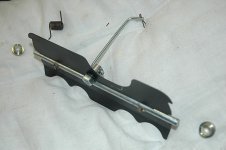
Is the small spring fitted right? Fitted the thermostat repair kit and it also contained this long threaded 6mm "bolt". What is it for?

31122012381.jpg
 
Back
Top